Thursday, November 25, 2021

Engraftment monitoring: part I

Following transplant of hematopoeitic stem cells, one must carefully follow up the patient for months. This is because the aim of a bone marrow transplant is to reconstitute the immune system, or - to be more precise - to borrow some immunity from a donor. Which means, eventually, that at some point of time, most of immune system (i.e. the white blood cells) of the recipient has to be replaced entirely by the donor's. In essence, the recipient will become a genetic chimera, carrying a distinct cell population with the donor's genome.

Now, how do you know when that happens? White blood cells look all alike under the microscope, and there is no telling whether it belongs to the patient or donor just by looking at them. Which brings us to they key question of identity, i.e. how am I any different from you?

If the donor and recipient are of opposite gender, a simple karyotype from a sample of blood cells would easily identify which one is from whom. The Y chromosome will stand out. However:
1. If you have ever done cytogenetics, you know the mind-numbing labor that goes into karyotyoing
2. If multiple donors of different genders have donated stem cells to a single recipient (as is often the case), the method falls on it face.

So let's move on to genetic differences between two individuals. As members of the same species, we are more or less similar, except for a few things. Short tandem repeats (STR) are repetitions of a short nucleotide core (usually less than 9 nucleotides), which vary in repeat numbers between people. For example the donor might have:

GTCGTCGTCGTC

is a 4-repeat of a 3-sequence. Again, the recipient could have:

GTCGTCGTCGTCGTCGTCGTC

is a 7-repeat of the same. Which is to say that if you perform a polymerase chain reaction for this particular STR, the band for the donor and the recipient would show up at different places.

For small differences like a few nucleotides, gel electrophoresis is too low res. On capillary electrophoresis, the same would show up as two peaks.
Capillary electrophoresis of STR PCR; the exact height and area of the peaks are subject to PCR conditions, the loci being chosen and the relative difference in repeats between the two


Remember: PCR is competitive; shorter segments will eat up reagent nucleotides faster than longer ones (simply because the longer repeats need more time to copy). In this case, the difference 7-4=3 is not much; but if you pick a VNTR (variable number of tandem repeats) which are much more variable in repeats than STR, the difference can show up and skew the analysis in favor of the shorter allele.

Like every other gene, STRs are also inherited in two alleles: one maternal and one paternal. A person might have
  • homozygous at an STR locus, i.e. both alleles might have the same number of repeats
  • heterozygous, i.e. one allele has a 7-repeat, another a 3-repeat (i.e. the aforementioned scenario)
In an ideal scenario, the donor and the recipient have completely different STR alleles: maybe the donor has a 7-repeat and a 4-repeat, and the recipient has a 10-repeat and a 15-repeat. Which makes things really simple to analyse:

The proportion of donor cells in this case is simply the proportion of donor alleles (a & b) in the post transplant mix (green), i.e. 
The height/ area of the peaks reflect the relative proportion of the alleles in the mix (remember: all are competing for the same primer!)


(a + b)/ (a + b + c + d)

This simplest scenario is of course, quite idealistic. One won't often find such an STR between two individuals; and even if one does, it is not wise to assess engraftment by only one STR marker. Consider this particular situation where the exact same allele pair is carried by both donor and recipient.
This is a non-informative STR marker - because the donor and recipient carry the same allele pair

In other situations, there might be one common allele between the two.
The allele at extreme right is ahred between the recipient; the one at extreme left belongs to donor only. Thus, the proportion of the left allele in the final sample is the amount of chimerism

This is akin to the schema:
Here, the amount of chimerism is b / (b + d), i.e. pretend that 'a' is not there.

Saturday, May 22, 2021

Antigen titration for T cell stimulation

T lymphocytes don't 'naturally' respond to an antigen; for an antigen to elicit a T cell response

1. A T cell clone with that particular receptor must be present

2. There must be antigen presenting cells (dendritic cells/ macrophages/ B cells)

In vitro, in isolated mononuclear cell preparations from whole blood, the second point is not usually a problem. However, the first condition, presence of antigen specific T cell clone, varies. 

For example, for a disease like tuberculosis which is very prevalent in India, one might expect that everyone has at least a few T cell clones for tubercular antigens. However, if the person has never got actual tuberculosis disease, this clone will not be very large. For rare diseases (like Scrub typhus), one would expect an even lower proportion of antigen specific T cells.

Empirically, it is prudent to do a titration of a specific antigen - if only to see which dose does the T cell respond the most. It is not a very tightly controlled experiment, because

1. The total number of lymphocytes vary between people

2. The size of antigen specific T cell clones vary between person to person

3. The T cell response is not dose dependent

However, like all biological phenomenon, T cell stimulation is not an 'all or none' phenomenon, and some correspondence with dose of antigen is always observed. In this case, a whole cell lysate of Mycobacterium tuberculosis (the antigen) was used in increasing doses to stimulate T cells from a healthy person. Production of interferon gamma (IFNG) was used as a marker for T cell response.

1. CD4+ T cells were selected (first panel): the anti-CD4 antibody is tagged with APC

2. The IFNG producing CD4+ T cells are shown in sequence, with increasing doses of the antigen producing a higher proportion of IFNG+ T cells

The unstimulated population is used as a control to create the box ('gate') for IFNG+ T cells

The proportion of IFNG+ T cells plateaus at 7.5 microL of antigen dose, and thus this dose was selected.

Thanks Uddeep & Dr Abhinav 


Sunday, April 11, 2021

Oxidative burst

Neutrophils (& monocytes) produce hydrogen peroxide (through superoxide production) to kill phagocytosed bacteria. 

2O2 + NADPH —> 2O2•– + NADP+ + H+

This reaction is catalaysed by NADPH oxidase. A series of reactions then generates hydrogen peroxide from this superoxide radical, and finally hypochlorous acid.

In vitro, this reaction can be visualised by Dihydrorhodamine (DHR), which is oxidised by H2O2 from normal, stimulated neurophils to give fluorescence (in the FITC channel). EDTA/ heparin blood must be used within 2 hours of collection, in room temparature all the time.

Gating neutrophils, lymphocytes and monocytes from whole blood

Before and after stimulation; note presence of DHR peak ('oxidative burst') in neutrophils and monocytes, and not in lymphocytes

The lack of superoxide produces a (weirdly named) disease.

Chronic granulomatous disease

Well, this has got (almost) nothing to do with granulomas (maybe a little, indrectly). This is a defect in several components of NADPH oxidase, resulting in inability to produce hydrogen peroxide. An X linked form (75%) & an autosomal recessive form (25%) occur.

Agent

XR: Mutation in phagocyte NAPH-O complex due to defect in gene for gp91phox.

AR: Defects in genes p47,67,22 phox or RAC2

It manifests as recurrent pyogenic infection with catalase +ve organisms.

Pathology

Three scenarios:

1. Normal neutrophils accumulate H2O2 in the phagosome containing ingested bacterium → MPO (myeloperoxidase) is delivered to the phagosome by degranulation, → H2O2 acts as a substrate for MPO to oxidize halide to hypochlorous acid and chloramines, which then kill the microbes. The quantity of hydrogen peroxide produced by normal neutrophils is sufficient to exceed the capacity of catalase, a hydrogen peroxide-catabolizing enzyme of many aerobic microorganisms.

2. When catalase +ve organisms such as E. coli gain entry into the CGD neutrophils, they are not exposed to hydrogen peroxide because the neutrophils do not produce it, and the hydrogen peroxide generated by microbes themselves is destroyed by their own catalase. Thus catalase-positive microbes, such as E. coli, can survive within the phagosome of the CGD neutrophil.

3. When CGD neutrophils ingest catalase negative organisms such streptococci or pneumococci, the organisms generate enough hydrogen peroxide to result in a microbicidal effect; i.e. they are killed by their own hydrogen peroxide.

(Ref: Williams, Hematology)

Thus there is a preponderane by recurrent infections by Catalse positive organisms.

CGD; note the lack of oxidative burst in stimulated neutrophils


Saturday, April 10, 2021

Foxp3

Titration of FoxP3 (tagged with PE). Note the gradual and slow population shift over increasing doses of antibody.  (UU - unstimulated unstained, US - unstimulated stained, SS - stimulated & stained)

As the dose of antibody is inreased, the entire helper T cell population is taking up the stain (which is unwanted behavior)

There is no drop in median PE expression with doses upto 10 microL. This means there might be yet more antibody targets left to bind


In this case, 2.5 miroL dose which gives good positive population (2.86%) without staining the negative population. So we select this dose.

Antibody clone: 236A/E7, FoxP3 - PE

Transforming growth factor beta 1

Titration of anti TGFB1 antibody

Without stimulation

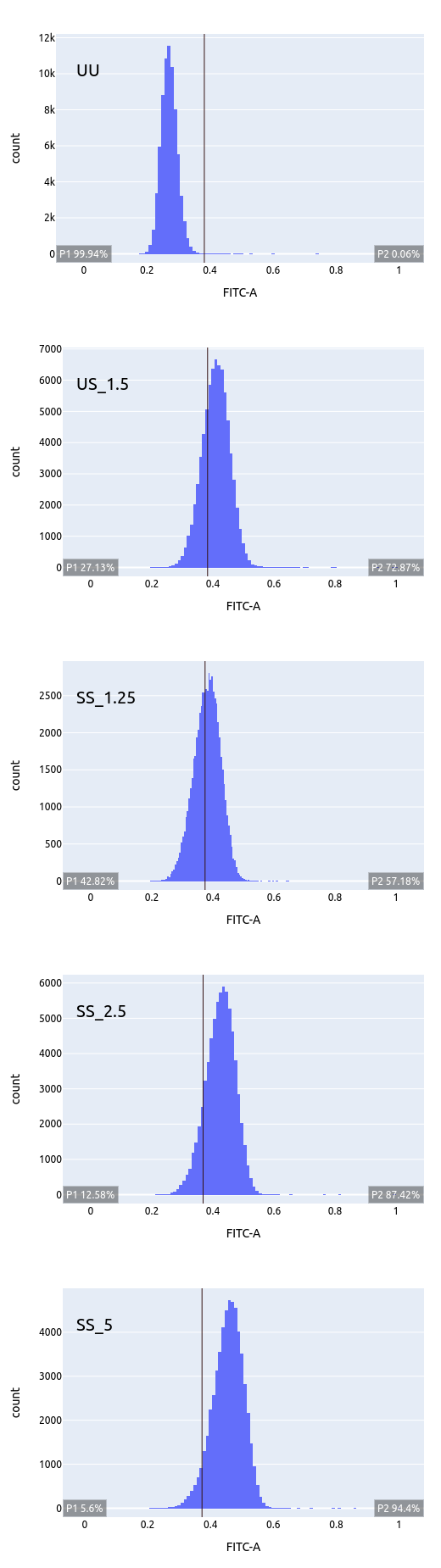
Titration plots for increasing doses of anti-TGFB1. Note the vertical line drawn at unstained (UU) and successive population shifts (non specific binding?). The ideal dose in this case must be close to 0.625 microL.

Doses ranging from 0.625 to 10 microL; note that entire cell population is moving

Plotting median FITC versus dose shows a continuously increasing trend. so no help from there!

With antigenic (MTb) stimulation

Does not make much of a difference


Thus, still undecided on the dose.

(Antibody clone TW4-9E7 bound to Alexa fluor 488, detected on FITC channel; cells - healthy peripheral blood mononuclear cells).


Tuesday, February 23, 2021

Titrating antibodies for flow cytometry

To determine the optimal dose of an antibody (which will bind cells at just the right proportion to generate a signal which is measurable within the limits of the lasers of the machine) is an exercise in perseverence. One must prepare serial dilutions of the antibody, isolate cells from blood (in this case, lymphocytes) and go on staining with each dilution of antibodies. 

Here, anti human FoxP3 has been prepared at doses of 5, 2.5, 1.25 and 0.625 microL (to stain one million cells, in each case). FoxP3 is a transcription factor expressed by a select set of T lymphocyte only upon stimulation by some external antigen. The graphs show staining intensity of the fluorochrome (in this case, phycoerythrin) as a histogram of cell counts, indicating expressionof FoxP3 inside the cells. Shift in median staining intensity has started to appear from 2.5 microL onwards. Note the difference between
  • peaks of unstained cells (blue) and unstimulated cells (green), as expected
  • peaks of stained cells, with increasing concentrations of antibodies, shown in progressively redder colors

The axis is logarithmic, so the differences between peaks are really much more than they seem

... as evident from the mean and median statistics (see legend of plot)

IL-17, the cytokine of acute inflammation, shows only a moderate increasewith stimulation.
Without stimulation, without staining for any antibody
Without stimulation, but with staining for any background IL-17 present

With stimulation; note the scattered points towards far right (high IL-17 expression)
With a constitutive surface marker like CD4, there is hardly any difference between unstimulated and stimulated
Orange - unstimulated, stained for CD4, green - stimulated and stained, purple- neither stimulated nor stained for CD4


Thanks Uddeep and Dr Abhinav Saurabh

Saturday, February 13, 2021

Antibody screening for transplant

Screening for preformed antibodies

In solid organ transplant, preventing hyperacute rejection is the primary aim. The recipient serum is tested for antibodies against the commonest HLA antigens in the population ('panel'); however, the sheer number of different HLA antigens (about 15000 and ever increasing) make it a difficult test to be done manually.

In the solid phase bead assay, single/ multiple such antigens are attached to plastic beads and read by a specialised flow cytometer.

No anti-MHC antibodies in recipient serum; transplant can proceed


Non specific antibodies binding to beads, mostly against DQ and DP antibodies; transplant can proceed

High titre of antibodies against MHC Class II (DQ); contraindication to transplantatinon

Very high titre of antibdies against MHC Class I; a definite contraindication to transpant


Column chromatography

 A jar of snacks (namkeens) demonstrate the principles of column chromatography to a fairly accurate extent. In a column consisting of diffe...